Friday, April 12, 2024

Introduction to Civil Engineering


Introduction to Civil Engineering 

Unit-I 

Mandate of Civil Engineers

Civil engineers deal with analysis, design, construction, maintenance and de-commissioning of the following civil facilities

·         Buildings: They provide safe shelter to people starting from low-cost housing to luxury apartments.

·         Roads: They provide smooth transportation of goods and people by constructing village roads, state highways, national highways,express highways, along with necessary bridges, fly-over, subways,etc

·         Irrigation structures: They provide controlled water supply for agriculture through construction of dams, canals, reservoirs along with flow control provisions like weirs, barrages, sluice gates, etc

·         Water supply: They provide potable water for domestic uses like drinking, bathing, washing, etc by constructing water storage structures (reservoirs, overhead tanks, etc), and water supply systems (pipe network, plumbing, etc)

·         Sewage disposal: They provide healthy disposal and treatment of used water by constructing sewage drains, sewage treatment plants, septic tanks, etc

·         Industrial structures: Huge power plants (thermal power plants, hydroelectric plants, nuclear power plants, etc), factories and manufacturing industries require special structures to house the equipments for proper functionsing.

·         Other means of transport: in addition to road transport, civil engineers provide railway tracks for goods, passenger and high-speed railway traffic. They construct harbours, inland water ways and airports.

·         Bridges: Gaps in smooth transportation are caused by obstructions like rivers, other road/ railway crossings and valleys. These gaps are bridged by constructing various kinds of bridges (cable-stayed bridges, cable suspension bridges, arch bridges, truss bridges, cantilever bridges, prestressed concrete bridges, etc) for roads, railway lines and for passing water canals

·         Tunnels: Passage through mountains is made shorter and faster by constructing tunnels through hills.


Civil Engineering specializations

 In order to provide industry-standard services in the wide variety of civil engineering domains, specializations are required for focussed training and excellence of quality. Accordingly, the following broad specializations are identified

·         Surveying:

o   Definition: It is the science and art of determining the relative postions of points on the earth’s surface by measuring distances, direction and vertical heights directly or indirectly.

o   Application: Surveying helps in preparing maps and plans, which help in project implementation. For example, when setting out the alignments for roads, railway lines, canals, etc, when deciding the location of a dam or airport or harbour, marking the locations of various rooms of a house, etc surveying is done.

o   Quantity surveying: Surveying also involves estimating the cost of the facility being constructed before starting.

o   Modern surveying: In modern days, a lot of surveying happens by remote sensing of data by satellites, drones, etc

·               Geotechnical Engineering:

o   Role: Any civil engineering structure will ultimately rest on the ground which is either soil or rock. The safe transfer of various forces from the civil engineering structure to the ground is ensured by geotechnical engineers.

o   Application: Knowledge of Geotechnical engineering is required for foundation design, earthen dams, embankments, roads and railway tracks, retaining walls,etc

o   Method: They assess the engineering properties of soils to ensure safe and serviceable performance of the structure under both short and long term loads.

o   Prior Knowledge: The knowledge of geology is very much important for Geotechnical engineers

·         Structural Engineering:

o   Def: Structure is any element that resists loads by deformation

o   Examples: There are many structures like buildings, bridges, dams, fly-overs, water tanks, etc

o   Each structure can have many components like slabs, beams, columns, foundations, etc

o   Objectives: The components, their connections, the overall structures are to be designed in such a way that they remain safe and can be used for the desired purpose for which they are meant.

o   Prior Knowledge: The knowledge of mechanical properties of materials, loading, methods of analysis and design regulations is required to be a structural engineer.

·         Transportation Engineering

o   Applications: It includes the facilities for various means of transportation, like roads, railway lines, airports, harbours, inland waterway, etc

o   Roads and railway tracks: The roads & railway tracks should be of sufficient strength to bear the loads of heavy vehicles, proper alignment to ensure safe visibility, proper elevation to ensure safety at all speeds, proper drainage and many other requirements for safe operation of vehicular traffic.

o   Airports: Airports require strong runways that work in all environmental conditions, taxiways, terminal buildings, control towers, etc

o   Ports and Harbours: These facilities are needed to dock ships of various sizes so that they can be loaded/ unloaded with cargo, and also for their regular maintenance and repair works.

·         Irrigation and Water reources engineering

o   Definition: Irrigation is the process of supplying water by artificial means to agricultural fields for raising crops. Where rainfall or ground water is insufficient, water flowing in a river can be stored by constructing dams, and diverting the water into the canals and conveyed to agricultural fields

o   Mandate: In addition to, the dams and canals, structures which measure & control the flow, likes weirs, barrages, etc and bridges for canals (aqueducts), are designed by water resource engineers. Facilities required for power generation through hydro-electric projects are also part of water reource engineers

·         Water supply and wastewater engineering (Environmental Engineering) :

o   Importance: people in cities, towns and villages need potable water for various domenstic purposes. Many industries like textile industry, leather industry, etc need reliable supply of water. The water available may not be fit for direct consumption. In such cases, water should be treated (purified) and supplied to public

o   Role:

§  Water sources are to be identified and developed.

§  For water purification, sedimentation tanks, filters beds, etc should be designed and maintained. Suitable pipelines are to be designed to supply water to individual consumer

§  The waste water (Used water) is to be collected and disposed off safely without causing damage to sustainability of ecology.

o   Environmental engineering also involves assessment of impacts caused by human activities on environment and ecology, assessment of pollution levels, disposal of solid waste, e-waste, industrial wastes, etc

·         Building materials and construction Technology

o   Importance: A wide range of materials and equipments are used in building construction. It becomes important for any construction engineer to be well versed with their properties and their application in varying circumstances. In addition, the efficient use of man-power and other resources at the construction site is of utmost importance for economical and safe implementation of any construction project.

o   Role: Planning & managing the sequence of activities along with the required resources, so that the project is completed efficiently and economically within the given timelines.


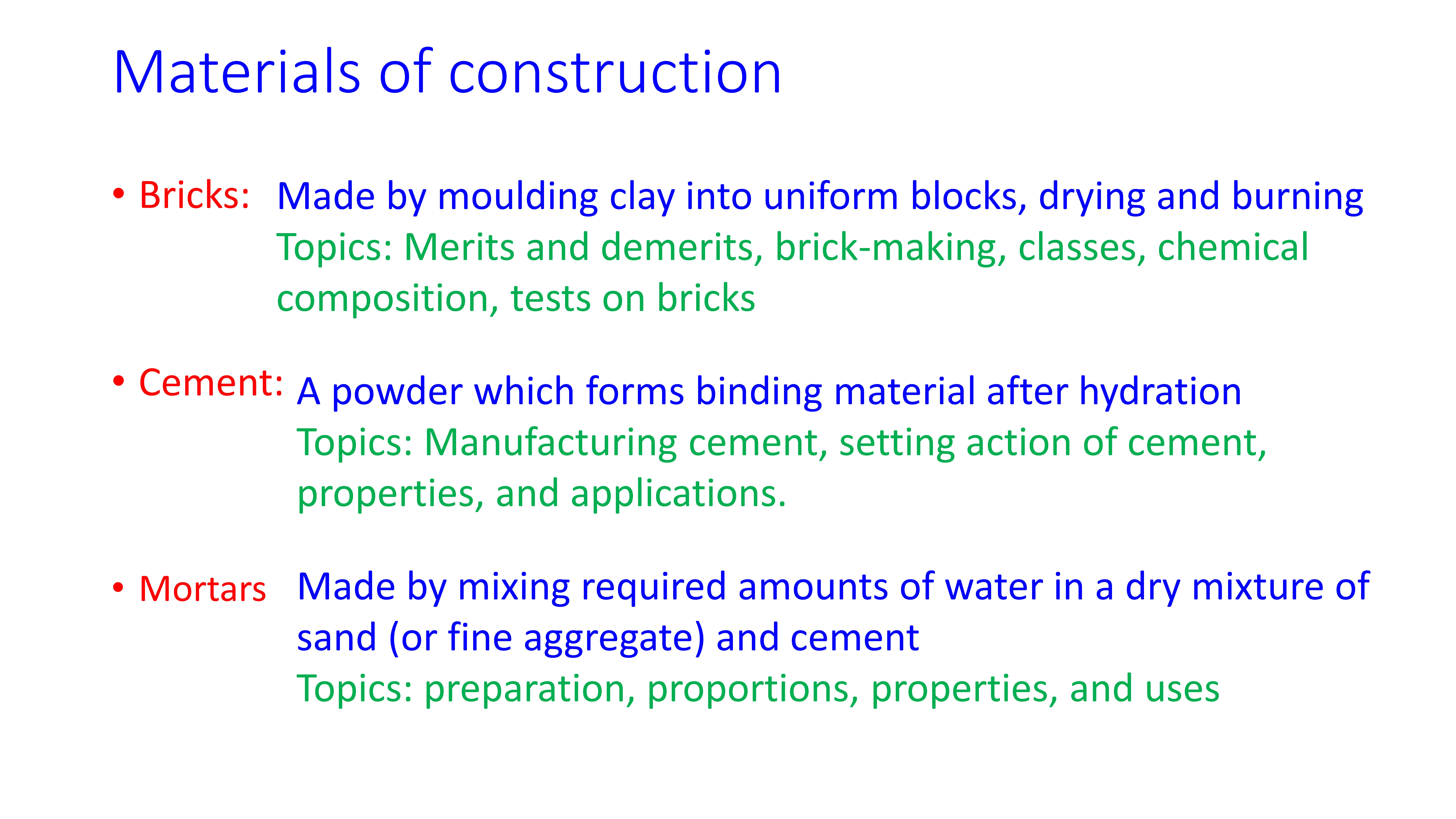
 Materials of construction

General

o   Any engineering structure makes use of wide variety of materials

o   These materials can be referred to as engineering materials or building materials or construction materials

o   One should know their properties to have a safe, economical and serviceable product (structure)

o   The building materials usually are selected based on their

o   Easy availability in required amounts

o   Strength, stiffness, toughness, hardness, etc

o   Weight and cost

o   Properties in adverse environments like rain, direct sunlight, wind, earthquake, snow fall, etc

o   Examples

§  Stones

§  Bricks

§  Timber

§  Steel

§  Cement

·         Cement mortar

·         Cement concrete

§  Alternate building materials

§  Composites

§  Smart materials


Sunday, February 25, 2024

Disaster impacts


Unit 2 IMPACTS/ REPERCUSSIONS OF HAZARDS

2.1        Classification of Disaster impacts

1.      Social Impacts due to loss of lives

2.      Health impacts

3.      Socio-economic impacts

4.      Environmental impacts

5.      Ecological impacts

2.2        Impacts of Floods

Apart from loss of life (human and cattle) and damage to property, the devastating effects of floods include sense of insecurity and fear in the minds of people living in the flood plains. Other effects include

  • agony of survivors,
  • spread of epidemics,
  • non-availability of essential commodities, and medicines,
  • loss of dwellings
  • damage of crops
  • damage of drinking water wells
  • damage of public utilities

2.3        Impacts of Droughts

The impact of droughts may be economical, environmental and social

  • Economic impacts
    • Loss of crops, which means loss to farmers, and increase od price
    • Loss of timber causing losses to timber industry
    • Loss of businesses in fisheries, farm equipment, fertilizers, food processing, etc
    • Loss in water transportation
    • Reduced hydro-power generation
  • Environmental impacts
    • Loss of fish and wild life habitat
    • Loss of foood and drinking water for humans and wild animals
    • Migration of men and animals
    • Increased stress to endangered species, leading to extinction of loss of biodiversity
    • Loss of tress and vegetation
    • Loss of reservoirs, lakes, ponds and wetlands
    • Increase in ground water depletion and land subsidence
    • Reduced water quality
    • Increased soil erosion due to winds
    • Degraded landscape
    • Increased number of fires and loss of forest and human habitat
  • Social impacts
    • Large scale migration of people, resulting in loss of income, and mental and physical stress
    • Health and nutritional problems
    • Famine and hunger
    • Loss of human and animal life due to heat, hunger and depressions


2.4        Impact of landslides and avalanches

  • Block river flow, roads and communication lines
  • Immense loss to agricultural production and land area
  • Causes series caualities
  • Causes flooding which worsens situation

2.5        Impacts of cyclones

  • Physical damage: The severest damage is caused by the floods, wind forces and storm surges, land-slides. Weak and light-weight structures razed to the ground.
  • Casualities and public health: Cyclones cause great damage to health. Viral infections are caused by violent winds. Epidemic diseases such as diarrhoeas, malaria, cholera, typhoid, jaundice, etc spread very fast.
  • Effect on water supplies: Flood water also causes havoc by contaminating surface waters and piped water supplies, and results in acute shortage of drinking water.
  • Damage to crops and food supplies: Cyclones accompanied by violent winds and torrential rains cause damage to the standing crop and stocked food grains in the low-lying areas. Sea water flooding increase the salinity and make the soil unsuitable for cultivation purpose.
  • Damage to communication and transport: The cyclonic winds completely smash the commmunication and trnasport system.
  • Damage to essential services: The cyclonis winds badly damages and disrupt the essential services like electricity, sewage disposal and water supply.


2.6        Impacts of Volcanic eruptions

The impacts of Volcanic eruptions are usually local or regional. Moreover, the changes in ecosystems and environment are reversible over passage of time

  • Due to volcanic eruption, mammals, birds and many small terrestrial animals are wided out.
  • The gases, smoke and ash unleashed from the volcano cause sever heat in the area with temperatures exceeding even 800°C.

2.7        Impacts of Earthquakes

Earthquakes destroy large cities in a matter of seconds, and may take thousands of human lives.

  • In most earthquakes of high magnitudes or of shallow depth of focus,
    • all communications are destroyed,
    • ground fissures erupt ground water, and
    • large scale flooding caused due to obstructed drainage, building collapse
  • Damage beyond instantaneous damage
    • Collapse of transportation network: Due to damaged roads, rails and airports
    • Collapse of medical facilities: Too many people are injured to various degrees
    • Collapse of electricity, water supply and food supply
    • Collapse of communication systems
    • Secondary causes leading to loss of lives
      • Hunger
      • Epidemic
      • Cold
      • Shock & trauma
      • Lack of medical attention


2.8        Impact of mining

Mining is a man-made activity. Thus, it can be planned, controlled, and mitigated with systematic efforts. Mining is of two types: 1. Surface or open cast mining, 2. Under-ground mining. Both these types involve the following environmental impacts. (Link)

1.      Air pollution: Dust from mining causes air pollution. The major components of particulate matter in air pollution are sulfates, nitrates, ammonia, sodium chloride, black carbon, mineral dust and water. Many of these come from mining activity

2.      Water pollution: The chemicals released from mining activities cause contamination of soil, groundwater, surface water. Mining activities cause noise pollution too.

3.      Land subsidence: This can in turn cause damages to the buildings, surface drains, highways, water and sewage lines, etc existing on the ground

4.      Land degradation: After mining is completed, the waste products of mining, known as mine-spoils, are simply left in their original location. This results in significant land degradation and pollution in those areas and nearby areas. Mining can cause erosion, sinkholes, loss of biodiversity, or the contamination of soil, groundwater, and surface water by chemicals emitted from mining processes. These processes also affect the atmosphere through carbon emissions which contributes to climate change

5.      Deforestation: With open cast mining the overburden, which may be covered in forest, must be removed before the mining can commence. Although the deforestation due to mining may be small compared to the total amount it may lead to species extinction if there is a high level of local endemism

6.      Noise, ground vibrations and dust pollution. Blasting causes heavy ground vibrations, damages to nearby structures, buildings, etc, besides causing irritation to the residents

7.      Mining accidents and health hazards: The dust produced during mining operations is highly injurious to health and causes diseases related to lungs. Other common diseases are due to high levels of toxicity and tuberculosis, cough and cold, malaria, diarrohea, skin diseases, staining of teeth, joint pains, etc

2.9        Impact of water resource development projects

1.      Displacement of people

2.      Loss of bio-diversity

3.      Deforestation

4.      Soil erosion and reservoir sedimentation

5.      Water pollution

6.      Seismic impacts

7.      Effects on monuments and heritage sites

8.      Adverse effects of irrigation in command area, like water logging and soil salinity

9.      Adverse effects on health like increased incidence of malaria and water borne diseases

10.  Impact on aquatic life

11.  Land loss and change in land use

12.  Downstream impacts

13.  Air, noise and water pollution during construction

14.  Land slides

15.  Safety of workers during construction

16.  Quarrying

17.  Muck generation/ disposal of waste

18.  Vibration due to blasting and use of heavy machinery

19.  River water polution in the downstream command area due to increased use of chemical fertilizers and pesticides.

2.10        Impact of Highway projects

1.      Hill cutting

2.      Impact on flora

3.      Impact on fauna

4.      Impact on Land and soil

5.      Impact on sir quality

6.      Noise level

7.      Water quality

8.      Impact due to establishment of labour camp


Tuesday, February 6, 2024

Engineering Mechanics